Coupe de Ville
Years: 1970, 1972
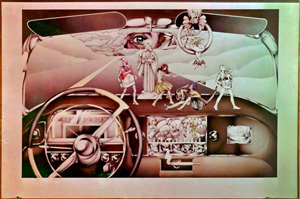
Joey Skaggs’ multi-media theatrical extravaganza, “Coupe de Ville”, was optioned for Broadway in 1972. When fate intervened and it didn’t materialize, Skaggs became further convinced to pursue his own projects and maintain control over his work.
In 1970, Joey Skaggs conceived a multi-media theatrical musical called “Coupe de Ville.” The entire theater was designed to resemble the inside of a 1950s-era Cadillac Coupe de Ville automobile. The stage was a giant dashboard complete with a steering wheel, instrument panel, radio, and ashtray. The windshield served as a movie screen showing what was happening outside the car, while the rear-view mirror was another screen displaying the people inside the car. The objects on the dashboard, including a plastic Jesus, a pair of sunglasses, a pack of cigarettes, baby booties, a skull, two magnetic Scottie dogs, a hula girl, and a pair of dice, were the actors. These objects formed the “Greek chorus” whose dialogue propelled the plot as the car changed owners, each with their own compelling stories.
Live musicians performed in the radio, and as the channels on the radio were changed, the music would switch from classical to jazz to blues to rock, including commercials, weather updates, and news. The entire experience was an American odyssey of personal entanglements and conflicting values, driven by themes of politics, racism, sexism, consumerism, and humor. The theater program was designed as a map of America, and the tickets were shaped like car keys. Audience members, seated in their places, were literally taken for a ride.
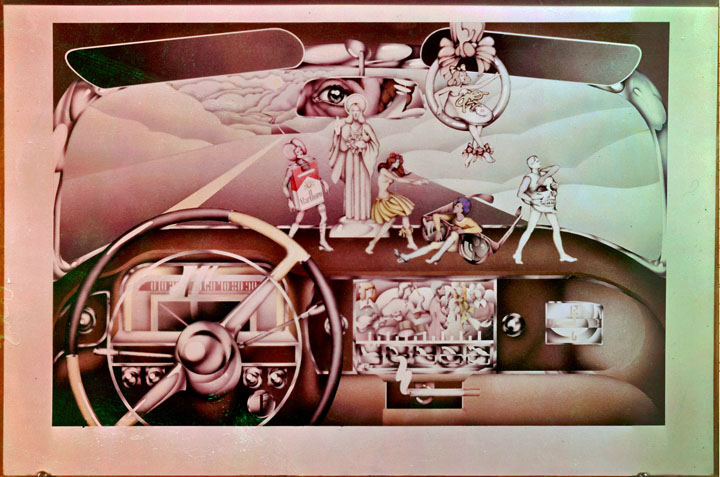
Illustration by Nick Gaetano of Joey Skaggs’ “Coupe de Ville” Set Design
“Coupe de Ville” was optioned by Michael Butler, the producer of the Broadway hit “Hair.” His company, Natoma Productions, planned to bring “Coupe de Ville” to Broadway as well.
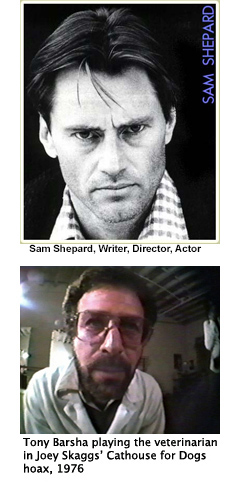 Skaggs was represented by the William Morris agency, first by exxecutive vice president Howard Hausman and later by agent Barry Weiner, and decided to involve his friends Sam Shepard and Tony Barsha: Sam to write the dialogue and Tony to direct the play.
It was an extravagant, revolutionary, and challenging multi-media event for that era, which is why there was so much interest in it. It was, however, technically difficult and very expensive to produce.
When Michael Butler’s fortunes shifted, and Sam Shepard traveled to England to direct and write several other plays, the collaboration ended.
Sam Shepard went on to write and direct prolifically, becoming, by 1980, the most produced playwright in America after Tennessee Williams. He also became a well-known Hollywood actor. Tony Barsha continued to write and direct. He also taught screenwriting at NYU. Over the years, he had cameos in several of Skaggs’ performances, appearing as the veterinarian in his Cathouse for Dogs in 1976, playing a bad guy in Skaggs’ Bad Guys Talent Management Agency in 1984, and appearing as a commando in the Fat Squad in 1986.
Many decades later, “Coupe de Ville” remains culturally relevant and, interestingly, is now completely feasible technologically.
Hook:
Line:
Sinker:
Documentation:
Categories:
Coupe de Ville
Years: 1970, 1972
Joey Skaggs’ multi-media theatrical extravaganza, “Coupe de Ville”, was optioned for Broadway in 1972. When fate intervened and it didn’t materialize, Skaggs became further convinced to pursue his own projects and maintain control over his work.
In 1970, Joey Skaggs conceived a multi-media theatrical musical called “Coupe de Ville.” The entire theater was designed to resemble the inside of a 1950s-era Cadillac Coupe de Ville automobile. The stage was a giant dashboard complete with a steering wheel, instrument panel, radio, and ashtray. The windshield served as a movie screen showing what was happening outside the car, while the rear-view mirror was another screen displaying the people inside the car. The objects on the dashboard, including a plastic Jesus, a pair of sunglasses, a pack of cigarettes, baby booties, a skull, two magnetic Scottie dogs, a hula girl, and a pair of dice, were the actors. These objects formed the “Greek chorus” whose dialogue propelled the plot as the car changed owners, each with their own compelling stories.
Live musicians performed in the radio, and as the channels on the radio were changed, the music would switch from classical to jazz to blues to rock, including commercials, weather updates, and news. The entire experience was an American odyssey of personal entanglements and conflicting values, driven by themes of politics, racism, sexism, consumerism, and humor. The theater program was designed as a map of America, and the tickets were shaped like car keys. Audience members, seated in their places, were literally taken for a ride.
Illustration by Nick Gaetano of Joey Skaggs’ “Coupe de Ville” Set Design
“Coupe de Ville” was optioned by Michael Butler, the producer of the Broadway hit “Hair.” His company, Natoma Productions, planned to bring “Coupe de Ville” to Broadway as well.
Skaggs was represented by the William Morris agency, first by exxecutive vice president Howard Hausman and later by agent Barry Weiner, and decided to involve his friends Sam Shepard and Tony Barsha: Sam to write the dialogue and Tony to direct the play.
It was an extravagant, revolutionary, and challenging multi-media event for that era, which is why there was so much interest in it. It was, however, technically difficult and very expensive to produce.
When Michael Butler’s fortunes shifted, and Sam Shepard traveled to England to direct and write several other plays, the collaboration ended.
Sam Shepard went on to write and direct prolifically, becoming, by 1980, the most produced playwright in America after Tennessee Williams. He also became a well-known Hollywood actor. Tony Barsha continued to write and direct. He also taught screenwriting at NYU. Over the years, he had cameos in several of Skaggs’ performances, appearing as the veterinarian in his Cathouse for Dogs in 1976, playing a bad guy in Skaggs’ Bad Guys Talent Management Agency in 1984, and appearing as a commando in the Fat Squad in 1986.
Many decades later, “Coupe de Ville” remains culturally relevant and, interestingly, is now completely feasible technologically.
Hook:
Line:
Sinker:
Documentation:
Categories: