Barges on the Hudson
Year: 1969
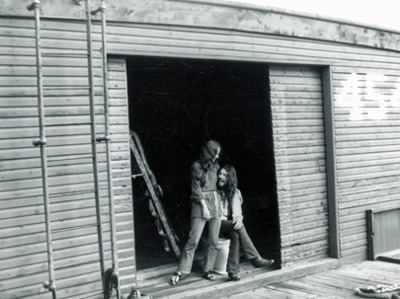
“One grisly Dutch captain lived on a barge with a speakeasy with a bar and juke box that played 78 RPM records. He and I often played chess as he told me stories of days gone by.” – Joey Skaggs, from Lucky Loser, My Aborted Attempt to Kidnap Sam Shepard
In 1969, Joey Skaggs began looking for an alternative to renovating another raw industrial loft in New York City, which at the time was how many downtown artists could afford to live and work. Inspired by the floating artist community in Sausalito, California, he imagined creating a similar lifestyle in New York.
He investigated several types of boats, including a Chesapeake Bay troller, a tugboat, a retired Staten Island ferry, and a wooden railroad barge once used to transport cargo along the Hudson River. Ultimately, he bought a Pennsylvania Railroad barge. Approximately 110 by 30 feet and featuring a captain’s cabin, massive cargo doors, and large roof hatches, it was a raw industrial space that could readily be converted into a studio and home.

Finding a place to moor it was a challenge. The 79th Street Boat Basin on Manhattan’s Upper West Side rejected Skaggs’ barge outright. Uninterested in mooring on Staten Island, he began searching along the New Jersey side of the Hudson River for a place to dock. Down a dirt road, across railroad tracks, and through a tangle of bushes, weeds, and sumac trees, he discovered a neglected marina in North Bergen with an extraordinary view of the Manhattan skyline.

There he met Audrey Boyer, who lived on a converted barge and held the lease to the marina’s riparian rights, along with several longtime barge dwellers who welcomed him into their unusual community. Although everything about the place seemed weathered and worn, its residents eagerly shared their knowledge of maintaining and living aboard barges.
The Hudson River flows at different speeds across its width, faster along the Manhattan shoreline and slower along the New Jersey side. Over time, silt carried downstream settled on the Jersey side, creating shallower water. The barges, with leaking hulls, often settled into the muddy riverbed as they gradually filled with water. Because the living quarters were above the waterline, they remained dry. To refloat a barge, bilge pumps had to be started while the tide was receding so the seams could be recaulked. When the tide returned, the barge would pop up from the mud and, with the help of a small motorboat, could be moved to another mooring. Skaggs began bringing in additional barges and other artists joined him.

He lived in a converted 60-passenger school bus while renovating the barge. He commuted to New York City by motorcycle. Before long, the neglected marina had become a small waterfront artists’ community, bringing new life and creative energy to the site.
This attracted media attention. Penthouse published a humorous feature describing his unconventional home in the second issue of the new magazine. Howard Smith wrote about Skaggs and the barges in his Scenes column in The Village Voice later that year, bringing both welcome publicity and unwanted attention.
North Bergen Mayor Angelo Sarubbi, whose construction company office overlooked the marina from above, took notice. He had plans to redevelop the waterfront into a multi-million-dollar marina, but he did not control the necessary waterfront rights.
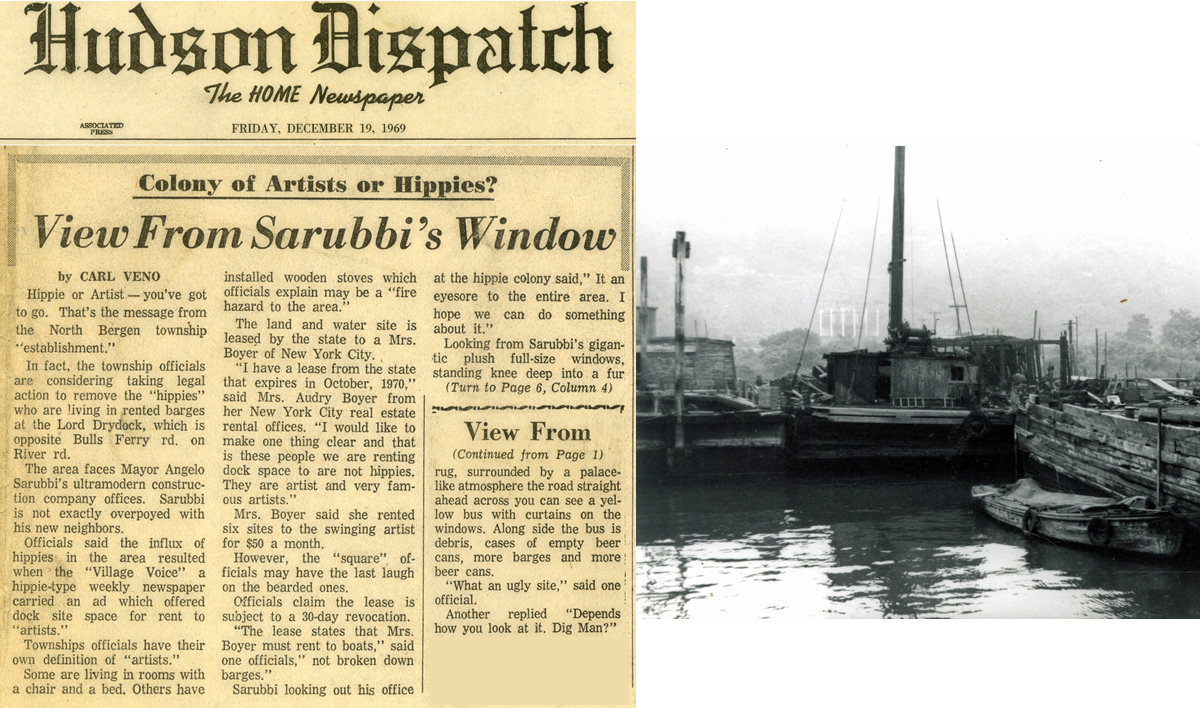
A campaign of intense harassment followed, including unfavorable local media editorials and uninvited visits from “officials” suggesting the artists were not welcome there.
Unable to mount an effective legal challenge, the community dissolved. Subsequently, Sarubbi was indicted on corruption charges for a host of illegal activities, ending his marina development plans.
Years later, in 2013, Skaggs wrote about his barge experience for HuffPost in My Aborted Attempt to Kidnap Sam Shepard.
Hook:
Line:
Sinker:
Documentation:
Categories:
Barges on the Hudson
Years: 1969
“One grisly Dutch captain lived on a barge with a speakeasy with a bar and juke box that played 78 RPM records. He and I often played chess as he told me stories of days gone by.” – Joey Skaggs, from Lucky Loser, My Aborted Attempt to Kidnap Sam Shepard
In 1969, Joey Skaggs began looking for an alternative to renovating another raw industrial loft in New York City, which at the time was how many downtown artists could afford to live and work. Inspired by the floating artist community in Sausalito, California, he imagined creating a similar lifestyle in New York.
He investigated several types of boats, including a Chesapeake Bay troller, a tugboat, a retired Staten Island ferry, and a wooden railroad barge once used to transport cargo along the Hudson River. Ultimately, he bought a Pennsylvania Railroad barge. Approximately 110 by 30 feet and featuring a captain’s cabin, massive cargo doors, and large roof hatches, it was a raw industrial space that could readily be converted into a studio and home.
Finding a place to moor it was a challenge. The 79th Street Boat Basin on Manhattan’s Upper West Side rejected Skaggs’ barge outright. Uninterested in mooring on Staten Island, he began searching along the New Jersey side of the Hudson River for a place to dock. Down a dirt road, across railroad tracks, and through a tangle of bushes, weeds, and sumac trees, he discovered a neglected marina in North Bergen with an extraordinary view of the Manhattan skyline.
There he met Audrey Boyer, who lived on a converted barge and held the lease to the marina’s riparian rights, along with several longtime barge dwellers who welcomed him into their unusual community. Although everything about the place seemed weathered and worn, its residents eagerly shared their knowledge of maintaining and living aboard barges.
The Hudson River flows at different speeds across its width, faster along the Manhattan shoreline and slower along the New Jersey side. Over time, silt carried downstream settled on the Jersey side, creating shallower water. The barges, with leaking hulls, often settled into the muddy riverbed as they gradually filled with water. Because the living quarters were above the waterline, they remained dry. To refloat a barge, bilge pumps had to be started while the tide was receding so the seams could be recaulked. When the tide returned, the barge would pop up from the mud and, with the help of a small motorboat, could be moved to another mooring. Skaggs began bringing in additional barges and other artists joined him.
He lived in a converted 60-passenger school bus while renovating the barge. He commuted to New York City by motorcycle. Before long, the neglected marina had become a small waterfront artists’ community, bringing new life and creative energy to the site.
This attracted media attention. Penthouse published a humorous feature describing his unconventional home in the second issue of the new magazine. Howard Smith wrote about Skaggs and the barges in his Scenes column in The Village Voice later that year, bringing both welcome publicity and unwanted attention.
North Bergen Mayor Angelo Sarubbi, whose construction company office overlooked the marina from above, took notice. He had plans to redevelop the waterfront into a multi-million-dollar marina, but he did not control the necessary waterfront rights.
A campaign of intense harassment followed, including unfavorable local media editorials and uninvited visits from “officials” suggesting the artists were not welcome there.
Unable to mount an effective legal challenge, the community dissolved. Subsequently, Sarubbi was indicted on corruption charges for a host of illegal activities, ending his marina development plans.
Years later, in 2013, Skaggs wrote about his barge experience for HuffPost in My Aborted Attempt to Kidnap Sam Shepard.
Hook:
Line:
Sinker:
Documentation:
Categories: